

EXPERT SLEEP GUIDE · LAST UPDATED AUGUST 2026 · BY LINCOVE SLEEP SPECIALISTS
Baffle Box vs Sewn-Through: Hold Your Comforter Up to the Light
Hold your comforter up against a bright window or a lamp and look at the stitching. If a grid of bright lines glows through where the seams run, it is sewn-through construction: the top and bottom shells are stitched directly together, so there is no down at all along those lines. Baffle box construction sets fabric walls between the two shells instead, so the fill lofts evenly and the seams stay as warm as the rest of the comforter. It is the one spec you can check yourself in ten seconds, and the one that decides whether you wake up cold in stripes.

EXPERT SLEEP GUIDE · LAST UPDATED AUGUST 2026 · BY LINCOVE SLEEP SPECIALISTS
Baffle Box vs Sewn-Through: Hold Your Comforter Up to the Light
Hold your comforter up against a bright window or a lamp and look at the stitching. If a grid of bright lines glows through where the seams run, it is sewn-through construction: the top and bottom shells are stitched directly together, so there is no down at all along those lines. Baffle box construction sets fabric walls between the two shells instead, so the fill lofts evenly and the seams stay as warm as the rest of the comforter. It is the one spec you can check yourself in ten seconds, and the one that decides whether you wake up cold in stripes.
Quick Answer: Four Things the Light Test Tells You
A bright grid means sewn-through — light passes straight through wherever the two shells are stitched together, because nothing is trapped between them at that line. The pattern you see is a map of every place your comforter has no insulation.
Even glow means baffle box — the seams look much like the middle of each chamber, because a strip of fabric holds the shells apart and lets down fill the corners. This is what you are paying the premium for, and it is visible in about five seconds.
Confirm it with a pinch — run your fingers along a stitch line and squeeze. If it flattens to two thin layers of fabric with nothing in between, that seam is a thermal gap. On a baffle box comforter you will feel a soft wall of fill resisting you instead.
It is not one cold spot, it is a grid — sewn-through seams run the full width and length of the comforter, so the cold arrives as lines laid across your body rather than a single draught you could roll away from. That is why it is hard to describe and easy to blame on the room.
Quick Answer: Four Things the Light Test Tells You
A bright grid means sewn-through — light passes straight through wherever the two shells are stitched together, because nothing is trapped between them at that line. The pattern you see is a map of every place your comforter has no insulation.
Even glow means baffle box — the seams look much like the middle of each chamber, because a strip of fabric holds the shells apart and lets down fill the corners. This is what you are paying the premium for, and it is visible in about five seconds.
Confirm it with a pinch — run your fingers along a stitch line and squeeze. If it flattens to two thin layers of fabric with nothing in between, that seam is a thermal gap. On a baffle box comforter you will feel a soft wall of fill resisting you instead.
It is not one cold spot, it is a grid — sewn-through seams run the full width and length of the comforter, so the cold arrives as lines laid across your body rather than a single draught you could roll away from. That is why it is hard to describe and easy to blame on the room.
How to Run the Light Test
Take the duvet cover off first, if you use one. A cover will mask the pattern completely and give you a false pass.
Stand in front of a bright window during the day, or hold the comforter a foot in front of a bare lamp at night.
Hold it up by two corners so the fabric hangs flat rather than bunching.
Look past the fabric at the light behind it and let your eyes settle for a few seconds.
Then pinch a stitch line between finger and thumb and compare it with the middle of the nearest square.
A glowing grid appears
Sewn-through. The seams have no fill in them and never did. Nothing you do to the comforter will change that, because it is a decision made at the sewing machine, not a sign of wear. Washing it, shaking it and buying a thicker cover will all leave the grid exactly where it is.
The light stays even
Baffle box, and the construction is not your problem. If you are still cold, look at fill weight instead: a lightweight comforter in a cold bedroom is simply the wrong weight, and that is a much easier thing to fix than a shell that was built wrong.
Why a Seam Is a Cold Spot
Down does not warm you. Air does. Each cluster is a tiny three-dimensional structure that traps still air, and the thickness of that trapped layer is the whole of the insulation. Loft is not a comfort feature; it is the mechanism.
A sewn-through seam takes that thickness to zero. The top shell is stitched to the bottom shell, the two fabrics touch, and along that line the comforter is one cotton sheet with a needle hole in it. Heat leaves by the shortest path available, so it leaves there. Because the stitching is a grid, so are the cold lines, and they sit across you rather than beside you.
Baffle box construction solves this by adding a third piece of fabric: a narrow vertical wall between the shells at every seam. The down cannot slide between chambers, and it can loft to its full height right into the corners. That extra fabric and the labour to set it are most of the price difference between a cheap comforter and a lasting one, and it is the part of a comforter you cannot see in a product photograph.
There is a third construction sitting between the two. Channel or karo-step comforters run long tubes down the length of the duvet with no cross-walls. They loft better than sewn-through, but the fill can travel from head to foot inside each channel, which is why some comforters end up thick at the bottom and thin at your shoulders by morning.
How to Run the Light Test
Take the duvet cover off first, if you use one. A cover will mask the pattern completely and give you a false pass.
Stand in front of a bright window during the day, or hold the comforter a foot in front of a bare lamp at night.
Hold it up by two corners so the fabric hangs flat rather than bunching.
Look past the fabric at the light behind it and let your eyes settle for a few seconds.
Then pinch a stitch line between finger and thumb and compare it with the middle of the nearest square.
A glowing grid appears
Sewn-through. The seams have no fill in them and never did. Nothing you do to the comforter will change that, because it is a decision made at the sewing machine, not a sign of wear. Washing it, shaking it and buying a thicker cover will all leave the grid exactly where it is.
The light stays even
Baffle box, and the construction is not your problem. If you are still cold, look at fill weight instead: a lightweight comforter in a cold bedroom is simply the wrong weight, and that is a much easier thing to fix than a shell that was built wrong.
Why a Seam Is a Cold Spot
Down does not warm you. Air does. Each cluster is a tiny three-dimensional structure that traps still air, and the thickness of that trapped layer is the whole of the insulation. Loft is not a comfort feature; it is the mechanism.
A sewn-through seam takes that thickness to zero. The top shell is stitched to the bottom shell, the two fabrics touch, and along that line the comforter is one cotton sheet with a needle hole in it. Heat leaves by the shortest path available, so it leaves there. Because the stitching is a grid, so are the cold lines, and they sit across you rather than beside you.
Baffle box construction solves this by adding a third piece of fabric: a narrow vertical wall between the shells at every seam. The down cannot slide between chambers, and it can loft to its full height right into the corners. That extra fabric and the labour to set it are most of the price difference between a cheap comforter and a lasting one, and it is the part of a comforter you cannot see in a product photograph.
There is a third construction sitting between the two. Channel or karo-step comforters run long tubes down the length of the duvet with no cross-walls. They loft better than sewn-through, but the fill can travel from head to foot inside each channel, which is why some comforters end up thick at the bottom and thin at your shoulders by morning.
The Three Constructions, Compared
Construction | How it is built | What you feel at 4am | Where the fill goes |
|---|---|---|---|
Sewn-through | Top and bottom shells stitched straight to each other in a grid. No third piece of fabric, so it is the fastest and cheapest to make. | Warm squares with cold lines between them. Most people describe it as the room being draughty rather than the comforter being wrong. | Stays inside its square, but can only loft to the height the stitching allows. |
Channel (karo-step) | Long tubes running the length of the duvet, walled along their sides but open end to end. | Good loft to begin with, then thin across the shoulders by morning as the fill settles toward your feet. | Travels freely from head to foot inside each channel. Needs shaking back into place regularly. |
Baffle box | Fabric walls set between the two shells at every seam, forming closed three-dimensional pockets. More material, more labour, higher price. | Even warmth edge to edge. There is no line you can trace with your hand and no pattern in the light. | Stays in its pocket and lofts to full height, including into the corners. |
Sewn-through is not a defect and it is not always the wrong buy. On a lightweight summer comforter the cold lines barely register, and it keeps the price down. It becomes a real problem the colder the room gets and the more you were counting on the down to do the work.
The Three Constructions, Compared
Construction | How it is built | What you feel at 4am | Where the fill goes |
|---|---|---|---|
Sewn-through | Top and bottom shells stitched straight to each other in a grid. No third piece of fabric, so it is the fastest and cheapest to make. | Warm squares with cold lines between them. Most people describe it as the room being draughty rather than the comforter being wrong. | Stays inside its square, but can only loft to the height the stitching allows. |
Channel (karo-step) | Long tubes running the length of the duvet, walled along their sides but open end to end. | Good loft to begin with, then thin across the shoulders by morning as the fill settles toward your feet. | Travels freely from head to foot inside each channel. Needs shaking back into place regularly. |
Baffle box | Fabric walls set between the two shells at every seam, forming closed three-dimensional pockets. More material, more labour, higher price. | Even warmth edge to edge. There is no line you can trace with your hand and no pattern in the light. | Stays in its pocket and lofts to full height, including into the corners. |
Sewn-through is not a defect and it is not always the wrong buy. On a lightweight summer comforter the cold lines barely register, and it keeps the price down. It becomes a real problem the colder the room gets and the more you were counting on the down to do the work.
Two Comforters Built the Expensive Way
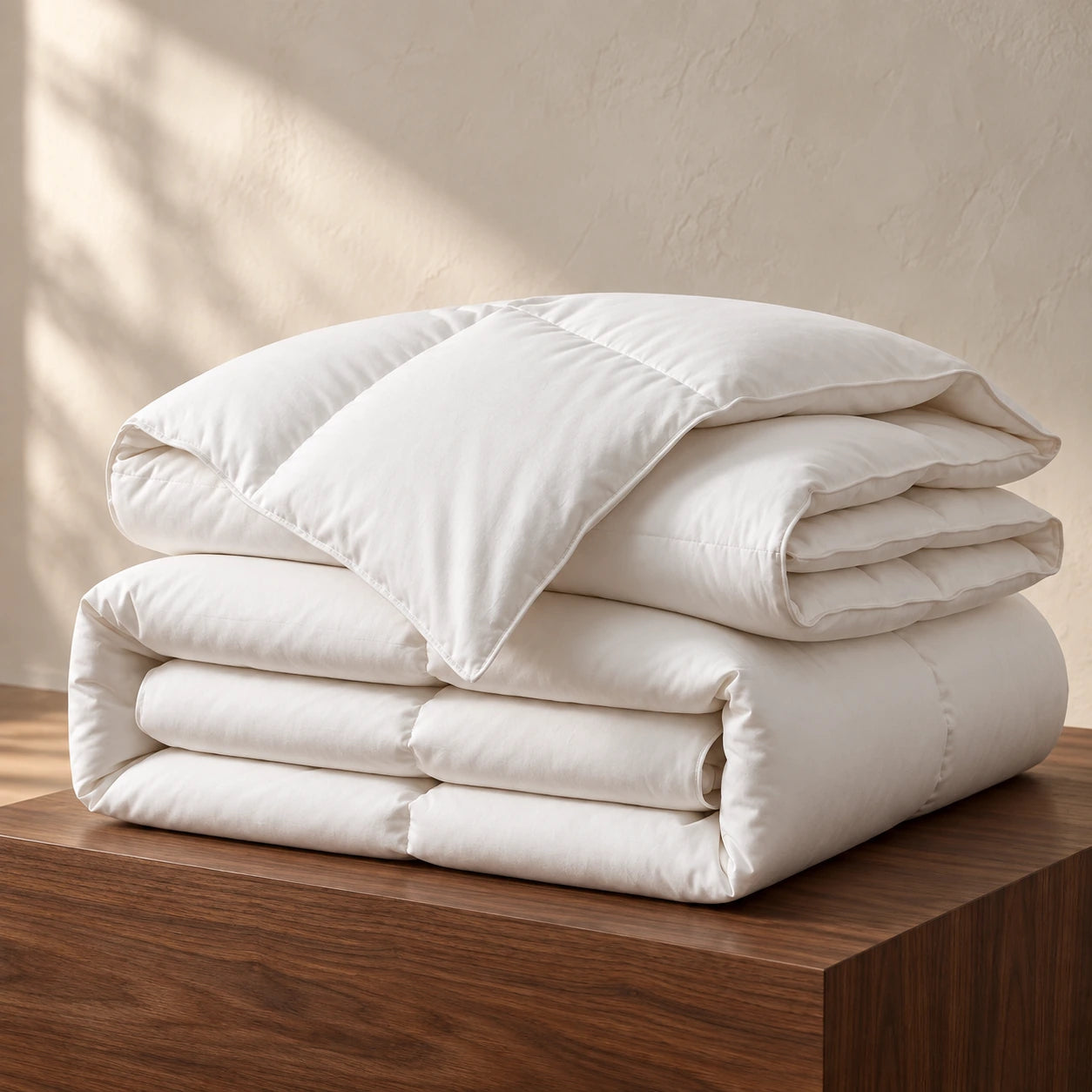
Both of these are true baffle box. Hold either one up to a lamp and the light comes through evenly, because there is down in every part of the shell including the seams.

THE EVERY-NIGHT ANSWER
100% Canadian White Down Duvet Comforter
True baffle box design with 800 fill power Canadian white down inside a 600 thread count cotton sateen shell, OEKO-TEX and RDS certified, with built-in corner loops for a duvet cover. Choose All-Season or Lightweight by how cold your bedroom actually gets. Sixty nights to decide, and a 5-year limited warranty.

THE CEILING
The Lincove Eiderdown Comforter
Rare eiderdown in a 100% cotton sateen shell, for people who want the warmest possible layer at the lowest possible weight. This one is custom made to order rather than held in stock, so it is a considered purchase: returns are eligible for 50% store credit, and there is no sleep trial on it.
Two Comforters Built the Expensive Way
Both of these are true baffle box. Hold either one up to a lamp and the light comes through evenly, because there is down in every part of the shell including the seams.
THE EVERY-NIGHT ANSWER
100% Canadian White Down Duvet Comforter
True baffle box design with 800 fill power Canadian white down inside a 600 thread count cotton sateen shell, OEKO-TEX and RDS certified, with built-in corner loops for a duvet cover. Choose All-Season or Lightweight by how cold your bedroom actually gets. Sixty nights to decide, and a 5-year limited warranty.
THE CEILING
The Lincove Eiderdown Comforter
Rare eiderdown in a 100% cotton sateen shell, for people who want the warmest possible layer at the lowest possible weight. This one is custom made to order rather than held in stock, so it is a considered purchase: returns are eligible for 50% store credit, and there is no sleep trial on it.
Frequently Asked Questions
What people ask us about comforter construction and cold spots.
Frequently Asked Questions
What people ask us about comforter construction and cold spots.
OUR METHODOLOGY
Written by Lincove Sleep Specialists
This guide draws on Lincove's twenty-plus years designing and filling Canadian down bedding, plus sleep-disruption data from 13,425 completed sleep-profile quizzes on quiz.lincove.com. One honest limit: our study asked people about their pillows and how they sleep, not about their comforters, so the disruption figures on this page describe the problem space rather than proving a comforter caused it. The construction claims are about how these products are physically built, and you can verify every one of them on your own bed in ten seconds, which is why we led with the test instead of the specification.
Downmark Certified
60-Day Sleep Trial
13,425-Person Study
OUR METHODOLOGY
Written by Lincove Sleep Specialists
This guide draws on Lincove's twenty-plus years designing and filling Canadian down bedding, plus sleep-disruption data from 13,425 completed sleep-profile quizzes on quiz.lincove.com. One honest limit: our study asked people about their pillows and how they sleep, not about their comforters, so the disruption figures on this page describe the problem space rather than proving a comforter caused it. The construction claims are about how these products are physically built, and you can verify every one of them on your own bed in ten seconds, which is why we led with the test instead of the specification.
Downmark Certified
60-Day Sleep Trial
13,425-Person Study
Keep Reading: Related Sleep Guides
Keep Reading: Related Sleep Guides
If the Grid Showed Up, You Know What to Do
A baffle box shell is the one thing you cannot add later. Lincove's Canadian Down Comforter comes in All-Season and Lightweight, with sixty nights to decide and a 5-year limited warranty. If your pillow is the other half of the problem, the two-minute sleep quiz will match loft and firmness to how you actually sleep.
Free shipping & returns in the USA and Canada · 5-Year Limited Warranty
If the Grid Showed Up, You Know What to Do
A baffle box shell is the one thing you cannot add later. Lincove's Canadian Down Comforter comes in All-Season and Lightweight, with sixty nights to decide and a 5-year limited warranty. If your pillow is the other half of the problem, the two-minute sleep quiz will match loft and firmness to how you actually sleep.
Free shipping & returns in the USA and Canada · 5-Year Limited Warranty